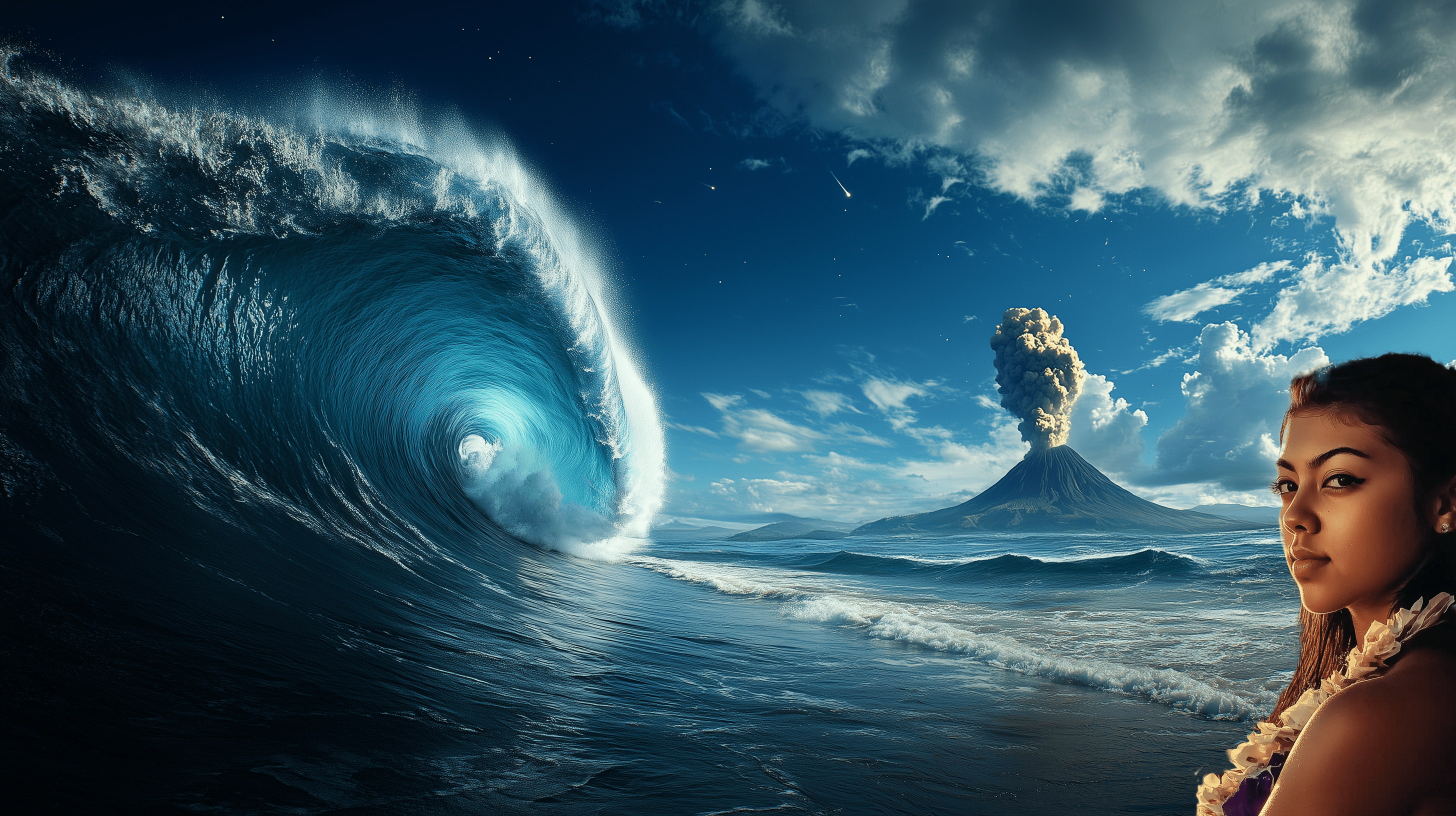
Follow Sage’s epic journey to a pristine ocean planet
Can the songs of the songs of Thalassa heal Earth?

Twelve light-years from Earth lies Thalassa,
an uncharted ocean planet shrouded in storms, secrets,
and the echoes of a vanished past
For Sage Thompson, a fallen big-wave champion haunted by loss and exile, the journey to Thalassa is a last shot at redemption. Once celebrated across the virtual surf world, she now rides the edge of obscurity. But this mission isn’t just about reclaiming a title—it’s personal. Her father vanished on Thalassa years ago during a doomed expedition. Now, Sage follows his path through space in search of answers.
What she finds is beyond imagining: a water-covered world teeming with alien beauty, spiritual resonance, and ethereal songs that speak directly to her soul. As rivalries ignite and ancient forces stir beneath the waves, Sage must confront the truth about her past, her culture, and the fragile line between science and spirit.
Part ecological parable, part cosmic adventure, Songs of Thalassa is a powerful tale of ancestry, awakening, and the mysterious intelligence of the sea.

Explore Procyon
Explore a young binary star system ravaged by asteroids

Discover Thalassa
Discover a dynamic ocean planet and its monster waves
Experience Sage’s Journey
Follow her heroic path to environmental consciousness
What people are saying about Songs of Thalassa:
“
…blends cutting-edge oceanography, marine biology, Hawaiian culture, and music into a delightful hard-SF tale sure to join the ranks of fine water worlds.”

Don Sakers, Analog Science Fiction and Fact Magazine
“
Hawaiian surfing, spirituality, science and science fiction merge in this futurist epic.”
David Helvarg, Author of The Golden Shore
>>> Excerpts from the book <<<

From Chapter 30, Songs of Thalassa
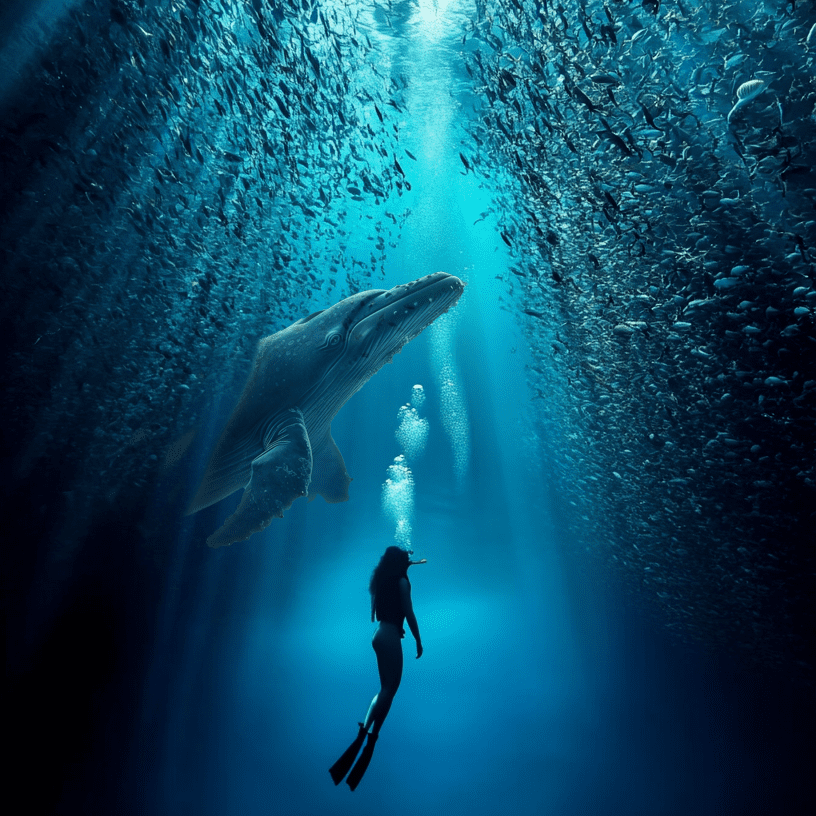
“A light caught her eye in the darkness as she saw a narrow vertical shaft filled with brilliant beams above. She swam toward it and noticed countless creatures floating peacefully in the narrow space: dime-sized versions of the green amoeba-plankton, copious jellies, and innumerable tiny transparent pika, and larval mantis squid bristling with appendages pulsing through the water, and a whole array of small creatures she’d never seen before. As she ascended toward the light, the living soup of creatures gently brushed against her. Surfacing inside a massive cavern, she took a huge breath. After her long submergences, it was a breath of life, and she felt resurrected into a new awareness.
Looking up, she saw rays beaming down from a skylight in the roof of the cave. Replenished and curious, she dove underwater and floated among the myriad current-flung creatures gently swirling around her; mixed in a sea of fine bubbles, their touch was an intensely personal experience. Here, in this moment, she was one creature among many and felt fully connected to the Thalassian sea and its life. All were one, just like the lichens, and they were aware of her. Her hands moved gracefully through the crystal-clear water as animals spun softly around them. Her hair entangled with sea life, and her feet created eddies, with small creatures circling in the whorls. It was her harmonious dance with life”
From Chapter 22, Black Rain
“Days ago, the eastern clouds merged with the western storm to form a giant dark mass of angry thunderheads as the wind howled through the valleys and along the cliffs. As the sky let loose its watery burden, the feeble streams grew into raging torrents. It was as if all of Thalassa’s great oceans had evaporated into the sky and were suddenly rushing back to the sea. The storm came in great thundering sheets of water pierced by lightning. Then it would die down for a few minutes or an hour, just enough for them to see the mainland across the bay through the mists, but then it would start up again.
A spider web of rivulets, streams, and rivers pouring off the island filled with so much yellow-red-black sediment that the sea had become a swirling cauldron of brown-and-white madness. The tides had grown frighteningly large, seemingly overnight. The inland sea drained at night then rushed back at dawn as a huge, frothing chocolate wall. In front of the cave, the sea came in from both sides, colliding in a gigantic upheaval of foam that shook the island in its rage. And it was growing; every day the tides were bigger, with the high tide approaching the edge of their cave. Although she had hope that it would completely drain the inland sea and they could scramble across, she worried about seeing her way through the veiled madness.”

 |  |  |
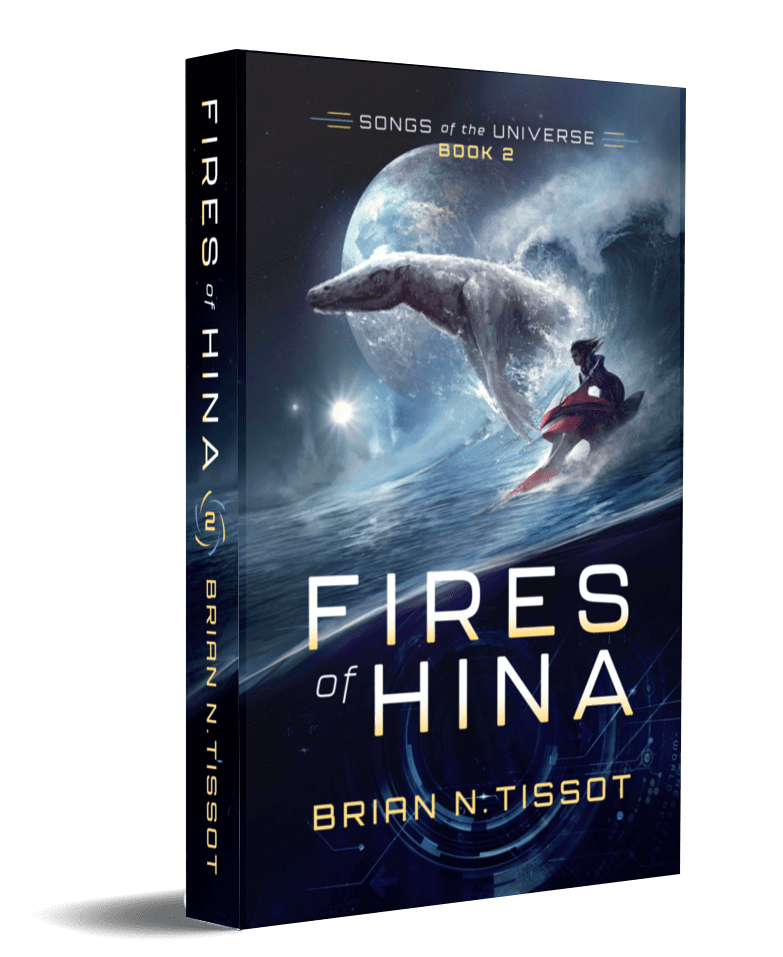
Explore the next book in the Songs of the Universe series

From the blog
-
The Birth of the Procyon System
While Thalassa is fictional, the science of the Procyon system in SOT is based on real research and our current understanding of stellar evolution and binary star systems. Gas & Dust The planet began two billion years ago as frozen clouds of dust and molecules dispersed across vast areas of space. Somewhere in the galaxy,…
-
Procyon In Hawaiian Voyaging Traditions
While Thalassa is a fictional planet, the science of the Procyon system and its role in mythology and Polynesian navigation is based on factual research. “O na hoku no na kiu o ka lani. ‘The stars are the eyes of heaven.’ “ – Hawaiian Sailing Proverb (Pukui, 1983) Procyon is a close stellar neighbor and…
-
Procyon: A System in Chaos
While Thalassa is a fictional planet, the science of the Procyon system in SOT is based on real research and our current understanding of stellar evolution and binary star systems. Procyon: A Binary Star System Procyon is the 8th brightest star in the night sky and thus a highly visible star. Together with Sirius (the…
-
The Fermi Paradox
The Fermi Paradox is a great way to think about the possibility of life, in this case technologically advanced civilizations in the universe. Below is the text from an early draft of SOT that was deleted from the book. This is a conversation the crew had in space on the way to Thalassa and is…
-
Mythology & Beliefs
A large part of SOT involves Sage’s cultural upbringing and her embracing of Hawaiian culture, and eventually a new worldview. Here I explore aspects of Hawaiian mythology and culture including in the book in more detail. I also explore the concept of Pantheism. “Hanau ka poThe night gave birth Hanau Kumulipo i ka po, he…
-
Music of Thalassa
Earth is teeming with life, all literally bursting with sound. On land we hear these sounds every day and most people are familiar with the noises of the forest: the hooting, chirping, moaning, howling, tweeting, clucking, whistling, squawking and hooting that creates a complex sonic melody. The sound of nature is everywhere but we don’t…
-
Sage: Heroine’s Journey
Sage’s story, like many in modern fiction, was modeled after Joseph Campbell’s The Hero’s Journey but adapted for a woman to the Heroine’s journey. To develop her story I used several books to guide me as well as feedback from female reviewers. These include Campbell’s book (1949), The Heroine’s Journey: Woman’s Quest for Wholeness by…
-
Maps of Thalassa
Included below are more detailed maps of Thalassa indicating major locations in the book. Spoiler Alert: the names of some locations may provide unwanted information about the plot and are best viewed after the book is completed.
-
Geology of Thalassa
The geology of Thalassa was created based on real-world examples of planetary dynamics on Earth and other planets, especially Mars. Here I present the research concepts I used to create the geology, geography, and oceanography of the planet. To begin, let’s travel back in time about 100 million years ago to the planet Thalassa… At…
-
Waves of Thalassa
So, you might ask, can we really surf on a planet like Thalassa? What does the science say? Believe it or not, this question has been studied and the answer is yes!. But as a surfer a better question is what kind of waves would we find? In SOT I based the waves at the…
-
Life on Thalassa
Although we have discovered thousands of exoplanets in the last decade we know of only one planet with life: Earth. So, as a marine biologist I based life on Thalassa using the scientific foundations and evolutionary history of what we know about primitive life on Earth, with some added twists of course. Since we don’t…
-
Origins of Thalassa’s Cetaceans
As a marine biologist I am always spellbound watching whales on the open sea. Witnessing their majestic movements, they are the most marine of all creatures, but I never fully appreciated their origins until I researched the topic before writing SOT. I focused on the ancestors of cetaceans because they are super-cool and are a…
-
Mysteries and Easter Eggs
There are many hidden mysteries and dilemmas in the book, some obvious, many not obvious. Here’s a list to get you thinking. You need to read the entire book to solve most of them. E-mail me with your discoveries: brian@briantissot.com